
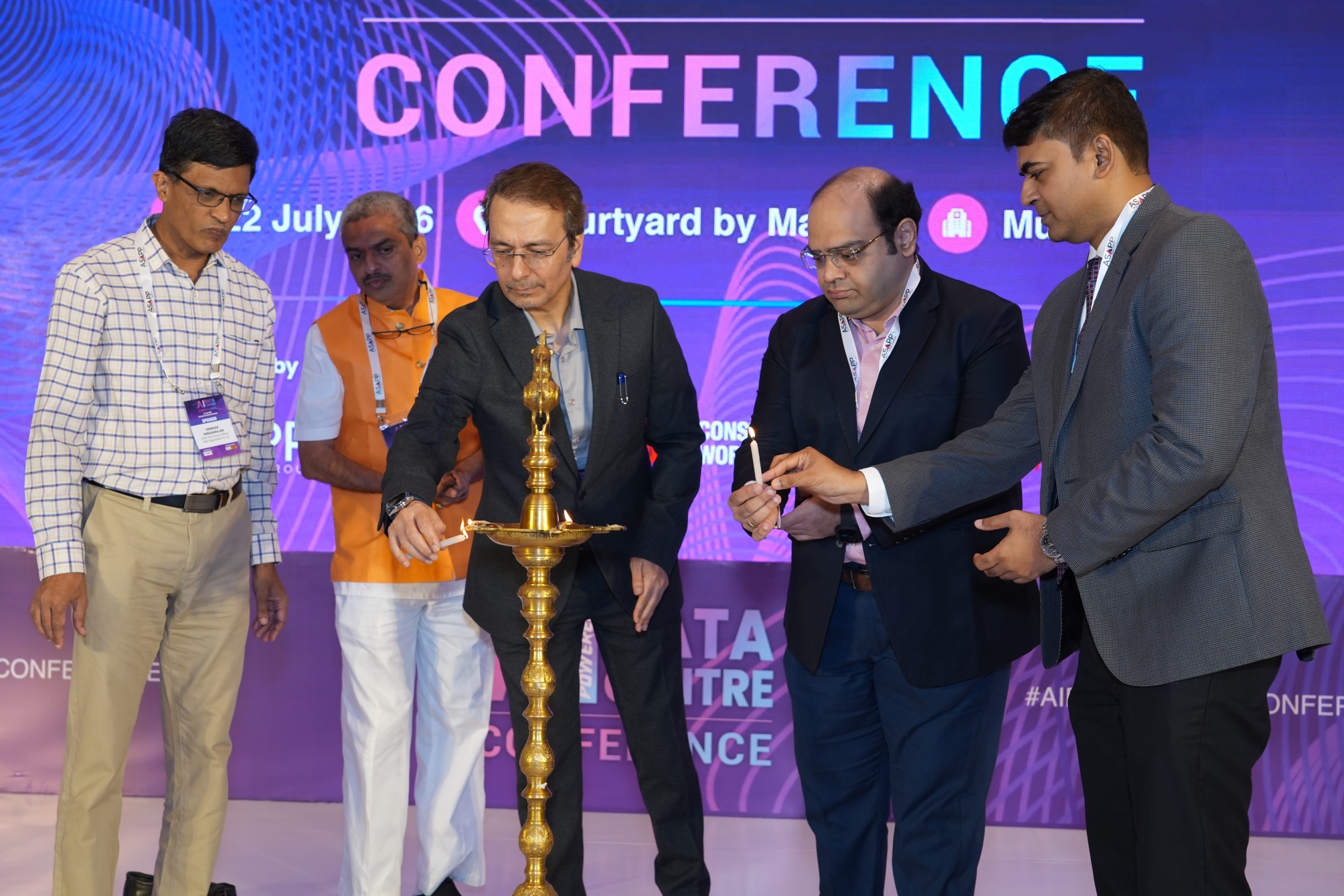
Industry experts deliberate on AI-ready infrastructure, sustainability and investment at the AI-Powered Data Centre Conference 2026 in Mumbai.
Mumbai, 23 July 2026: As artificial intelligence reshapes global digital infrastructure, industry leaders gathered in Mumbai today at the AI-Powered Data Centre Conference 2026 to discuss how India can build the capacity, technology and ecosystem required to emerge as a global AI infrastructure hub. Organised by ASAPP Info Global Group and conceptualised by FIRST Construction Council, the conference revolved around the theme, “From Capacity Gap to AI Superpower: Building India’s Digital Backbone for the Intelligence Economy.”
Bringing together developers, technology providers, enterprise users, consultants and policymakers, the conference explored the opportunities and challenges shaping India’s next generation of AI-ready data centres. Discussions ranged from investment trends and capacity creation to power infrastructure, advanced cooling technologies, sustainability and enterprise expectations, reflecting the industry’s growing focus on building resilient digital infrastructure.
Welcoming delegates, Pratap Padode, Founder & MD, ASAPP Info Global Group, said: “India’s own data centre capacity has grown from about 375 MW in 2020 to around 1.8 GW currently. The Ministry of Power has estimated that electricity demand from data centres in India could reach 13.56 GW by 2031–32. AI is no longer just a software story—it is a compute story, a power story, a cooling story, a water story and a data-governance story. India’s opportunity lies not only in building more data centres, but in building them responsibly. As we compete for investment, we must create green lanes for responsible investors while setting clear red lines that protect our infrastructure, our environment and our citizens.”
A common thread across the sessions was that India’s AI data centre opportunity extends far beyond building server capacity. Shrinivas R. Deshingkar, Founder and Chairman, Shree Tech Data, said such forums are essential for bringing the ecosystem together to identify practical challenges and develop collaborative solutions. While describing the sector as a tremendous opportunity for manufacturers, SMEs and the wider supply chain, he cautioned that power availability and skilled manpower remain pressing concerns. He urged the industry to invest in workforce development and indigenous manufacturing so that India is prepared for the next wave of AI-driven data centre growth.
Discussions on India’s expanding AI infrastructure market highlighted the urgency of accelerating project execution. Jay Bhurse, Chief Vision Officer, Prasa, observed that demand for AI infrastructure is significantly outstripping supply, creating immense opportunities for companies capable of delivering solutions faster. However, he noted that the same opportunity also presents the industry’s biggest challenge, with shortages of transformers, generators, construction materials and critical commodities threatening project timelines unless addressed through coordinated planning across the value chain.
Echoing the conference’s technical focus, Amit Agrawal, President, Techno Digital, said the gathering brought together every key stakeholder in the AI infrastructure ecosystem, enabling meaningful discussions around the practical challenges involved in building AI factories and next-generation data centres. He noted that India is poised for exponential growth in installed capacity and stressed that the country has an opportunity to learn from international markets and proactively address issues before they become barriers to long-term growth.
Sustainability remained central to the day’s discussions. Tanveer Ahmed, Business Head – Wet & Dry Cooling Solutions, Cooling Business, Thermax, said sustainability is fundamental to the long-term viability of AI infrastructure. He highlighted efficient cooling technologies, knowledge sharing and innovation as critical enablers for the industry while calling for stronger policy support, improved grid infrastructure and greater use of recycled water to ensure environmentally responsible expansion of India’s data centre capacity.
MK Uang, General Manager, APAC Business Group, Graid Technology, said AI data centres worldwide are increasingly constrained by power availability and thermal management rather than computing capability alone. He explained that improving data I/O efficiency can significantly enhance GPU utilisation, enabling operators to achieve higher AI performance while reducing energy consumption and easing power and cooling limitations.
Looking ahead, industry leaders remained optimistic about India’s global competitiveness. Rahul Sharma, Data Centre Expert, described the coming decade as India’s decade for data centres, while emphasising that execution excellence and delivery credibility will determine long-term success. Jagat Ram, Head – Data Centre Operation and Delivery, L&T, echoed this sentiment, calling for deeper collaboration across the ecosystem and greater investments in captive power, battery energy storage systems and advanced cooling infrastructure to deliver world-class AI-ready facilities.
The conference concluded with a forward-looking discussion on India’s AI infrastructure ambitions through 2030, examining future investment requirements, ownership models, enterprise demand and the country’s potential to become a global destination for AI infrastructure.
The conference was supported by Shree Tech as Gold & Delegate Bag Partner, Graid Technology Inc. and Suroj as Silver Partners, Prasa as Associate Partner, and IMPACCT as Business Intelligence Partner. Construction World and Infrastructure Today served as the official media partners.
